


Chongqing is a city full of layers—from its multi-dimensional transportation network and delicious spicy flavors to the blend of tradition and modernity. This guide will take you deep into this magical mountain city, from classic landmarks to hidden experiences, to help you plan an unforgettable journey.
This travel guide will help you with core experiences and food, transportation and accommodation, and the best time and number of days for your itinerary.
Article Preview
I. Core Experiences
II. Chongqing Cuisine
III. Transportation and Accommodation
IV. Best Time to Visit
V. Useful Tips
VI. Itinerary Suggestions
Eight Must-Visit Core Experiences
- Hongya Cave: A Real-Life Spirited Away
Hongyadong, located on Cangbai Road in Yuzhong District, boasts a history of over 2,000 years and is one of Chongqing’s most iconic tourist attractions. At night, the stilted buildings built into the mountainside are illuminated by warm yellow lights, stretching layer upon layer to the banks of the Jialing River, resembling the fantastical world of Miyazaki Hayao’s animated film “Spirited Away.”

- Lighting hours: 6:30 PM to 11:00 PM every night. Visitors are advised to arrive before 6:30 PM to capture the moment the lights come on.
- Internal structure: Hongyadong has 11 floors. Floors 4 to 8 are the food court, floors 9 and 10 are cafes and bars, and the other floors are mostly shops.
Best photo spots:
- Qianximen Bridge: The most classic panoramic viewing platform, overlooking Hongyadong and the river view.
- Across the street from the first floor of Hongyadong (Jiabin Road): Great for close-up shots from below, with excellent wide-angle effects, but very crowded.
- North bank of the Jialing River (Beibin Road/Jiangtan Park): Less crowded, suitable for photographing reflections in the water.
- Liberation Monument: The Heart of the City and a Historical Landmark
Liberation Monument is the geographical and spiritual center of Chongqing. Originally named the “Monument to the Victory in the War of Resistance Against Japan,” this monument stands amidst a bustling modern commercial district, symbolizing Chongqing’s important role in World War II. Foreign tourists can experience the blend of old and new local life here.

Suggested activities nearby:
- Stroll along the Bayi Food Street or Jiaochangkou Night Market to sample local snacks.
- Visit the Guotai Arts Center or Chongqing Art Museum to experience the local art scene.
- Shopping: The area around Jiefangbei boasts numerous international brands and local shopping malls.
- Liziba: A Light Rail Spectacle Weaving Through Buildings
The Liziba Light Rail Station is a vivid embodiment of Chongqing’s “three-dimensional city” concept. The light rail train passes through a residential building, creating a globally rare transportation spectacle.

How to experience it:
- Take Metro Line 2 from Niujiaotuo Station to Liziba Station. We recommend choosing a window seat, especially one near the front of the train, for a clear view of the train passing through the building.
- After getting off the train, exit from Exit 1. Cross the road to reach the observation deck and take photos of the train “diving” into the building.
- Yangtze River Cableway: An Aerial Corridor Spanning Two Rivers
The Yangtze River Cableway was once a daily means of crossing the river for Chongqing residents, but now it has become a unique way for tourists to experience the city’s mountainous landscape. The cableway spans the Yangtze River, connecting Yuzhong District and Nan’an District, with a total journey time of approximately 4 minutes.
Two entrances:
- North Bank Entrance (near Jiefangbei): Convenient transportation, but long queues.
- South Bank Entrance (Nanbin Road): Shorter queues, but relatively inconvenient public transportation.
- Ciqikou Ancient Town: A Microcosm of Old Chongqing
Ciqikou, known as a “microcosm of Chongqing,” is an ancient town surrounded by commercial streets yet still retaining the atmosphere of an old wharf. Visitors can see traditional crafts such as ancient oil pressing and sugar making.

Cultural Experiences:
- Baolun Temple: Participate in prayer or sutra copying activities.
- Baoshan Palace: Visit a Qing Dynasty Taoist temple.
- Hanlin Academy: Experience the cultural atmosphere of an ancient private school.
- Wulong Karst Landforms: A Natural Theater Deep Within the Earth
Wulong, about a 3-hour drive from downtown Chongqing, is a UNESCO World Natural Heritage site. Its karst landforms, including sinkholes, fissures, and natural bridges, have appeared in the movies Transformers and Curse of the Golden Flower.

- Recommendation: A one-day trip is not enough to fully experience Wulong. It is recommended to allocate at least 2 days to explore this “natural museum” on foot.
- Dazu Rock Carvings: A Thousand-Year-Old Story on the Rock Wall
Unlike the Dunhuang and Yungang Grottoes, the Dazu Rock Carvings are closer to everyday life, depicting themes such as raising chickens, herding cattle, and filial piety. The Thousand-Hand Guanyin statue is particularly stunning, with its thousand arms unfolding like lotus flowers, displaying exquisite details.

Recommended attractions:
- Baodingshan: The largest and best-preserved of its kind, it’s a highlight of the tour.
- Beishan Stone Carvings: Characterized by Guanyin statues.
- Nanshan Stone Carvings: Primarily cave carvings.
- Two Rivers Night Cruise: A Flowing Nighttime Landscape
Sailing on a cruise ship between the Yangtze and Jialing Rivers, the lights on both banks flow like a galaxy. Hongyadong, the Grand Theatre, and Nanbin Road create a mesmerizing skyline in the night.

Other options:
- Day cruise: Ideal for enjoying the river views during the day.
- Long-distance Yangtze River cruise: Departing from Chongqing port, the journey takes 3-4 days, passing through the Three Gorges and stopping at places like Fengdu and Baidi City. It’s a slow-paced way to deeply experience river culture.
Chongqing cuisine: spiciness is a battleground
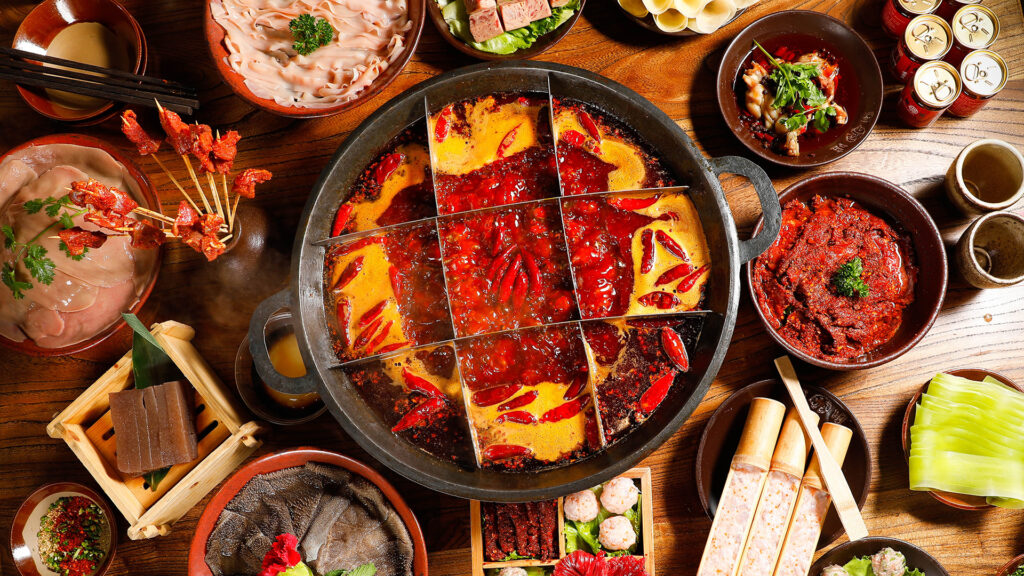
Chongqing’s food culture is centered around “spicy,” with hot pot, Chongqing noodles, local dishes, and barbecue each having their own unique characteristics.
Chongqing hot pot
originated along the Jialing River during the late Ming and early Qing dynasties. Foreign tourists can choose riverside hot pot (along the Jialing River) or air-raid shelter hot pot (such as “Dongdongli Hot Pot” and “Dongting Hot Pot”) to experience a unique dining environment.
Jianghu cuisine
Jianghu cuisine is characterized by its strong flavors and rustic cooking methods. Representative dishes include spicy chicken, boiled fish, and spicy blood curd. Its name originates from the saying “Wherever there are people, there is Jianghu,” reflecting the forthright and uninhibited character of Chongqing people.

Chongqing Noodles
A bowl of spicy noodles is often the start of breakfast for Chongqing locals. Tikan noodles, pea and minced meat noodles, and hot and sour noodles are local favorites. Every noodle shop in Chongqing has its own unique style.

Food Street Recommendations
| name | Features | Precautions |
|---|---|---|
| Jiefangbei Bayi Road Food Street | A concentration of snacks, easily accessible | Extremely crowded and noisy. |
| Guanyinqiao Food Street | A wide variety of food, well-managed, and affordable. | Crowded and noisy during peak hours. |
| Nanshan Garden Night Market | Beautiful environment, distinctive food and beverages | Remote location, long travel time. |
Transportation and Accommodation Guide
External Transportation
- Air: Chongqing Jiangbei International Airport offers numerous direct international flights, including routes from Singapore and Malaysia.
- High-Speed Rail: Chongqing boasts a well-developed high-speed rail network, with Chongqing North Railway Station connecting to most major cities in China.
Internal Transportation
- Public Transportation: Widest coverage, easily reaching most attractions with no risk of traffic jams.
- Taxi: Bright yellow taxis, convenient and fast, but prone to traffic jams during peak hours.
- Walking: Due to Chongqing’s complex terrain, walking is often the best way to connect short distances.
- Payment Methods: All public transportation supports cash or electronic payments (such as Alipay and WeChat Pay). Foreign tourists can register for Alipay International or open a WeChat Wallet in advance.

If you would like to learn more about transportation options in Chongqing, please see:Chongqing Transportation and Tourism Guide
Accommodation Recommendations
| Region | Suitable for | Features |
|---|---|---|
| Jiefangbei area | For tourists who enjoy a lively atmosphere and convenience | Shopping district right outside, night views within walking distance |
| Guanyinqiao area | For tourists who prefer delicious food and a lively local atmosphere | Numerous snack stalls, easily accessible by subway |
| Along Nanbin Road | Tourists who enjoy night views and river views | A stroll along the river in the evening is especially pleasant. |
Best time to visit Chongqing
Chongqing has a humid climate with four distinct seasons and no clear dry season. Rainfall is heavier from April to October each year, so it’s recommended to carry an umbrella, sunglasses, and sunscreen.
Best seasons: April-May and September-October, with mild weather and less rainfall.
Avoid crowds: During the National Day holiday (October 1st-7th) and the May Day holiday, scenic spots are extremely crowded.
Summer: Temperatures often exceed 40°C, but the night view is spectacular; be prepared for heatstroke.
Winter: Damp and cold, but less crowded; perfect for warming up with a hot pot.
Practical travel tips
To make your trip to Chongqing smoother, more comfortable, and safer, here are 15 practical tips covering aspects such as clothing, transportation, food, health, navigation, payment, language, cultural customs, and emergency response.
- Wearing a good pair of shoes is better than any mode of transportation.
Chongqing is known as the “Mountain City,” with extremely undulating terrain. Stairs, slopes, overpasses, and tunnels are everywhere. Even two adjacent locations that appear to be only 200 meters apart on a map may actually require climbing hundreds of steps or navigating an overpass. Therefore:
- Preferred: Non-slip, supportive athletic shoes or flat walking shoes.
- Avoid: High heels, new leather shoes, and hard-soled sandals.
- Additional tip: On rainy days, when roads are slippery, it is recommended to choose shoes made of waterproof materials.
- Public Transportation: Rail Transit is the Most Reliable Option
- Chongqing Rail Transit (Light Rail/Metro): Covers most attractions, operating from 6:30 AM to 10:30 PM, with frequent services and minimal traffic congestion. The carriages have announcements in both Chinese and English, as well as electronic displays.
- Buses: While the network is dense, it is susceptible to traffic jams, and station information is mostly in Chinese. Not recommended as a primary mode of transportation for first-time foreign visitors.
- Taxis (bright yellow): Low starting fare (approximately 10 RMB), suitable for short trips or nighttime travel. However, traffic is severe during peak hours (8-9 AM and 5-7 PM). It is recommended to use ride-hailing apps (such as Didi Chuxing, which supports an English interface).
- Walking: In core areas such as Jiefangbei, Hongyadong, and Ciqikou, walking is often faster than taking a vehicle. However, please check in advance whether the route includes significant uphill or downhill sections.
- Navigation Software: Google Maps is unreliable; Baidu or Gaode Maps are recommended.
- Reality: Google Maps updates data slowly in mainland China and does not support local features such as real-time public transport information or indoor navigation. For Chongqing’s complex terrain, it often displays “straight-line distance” while ignoring actual stairs and ramps.
- Recommended Solution: Download Baidu Maps or Gaode Maps (both have English interfaces or modes). They support walking navigation, real-time public transport information, and even “stairs/elevator” route suggestions.
- Tip: Pay attention to “elevation differences” when navigating. If the map shows 200 meters to your destination, but you encounter a wall or a deep embankment, you need to find an overpass or underpass.
- Introduce spicy food gradually and have stomach medicine on hand.
- Spiciness levels: What’s considered “mild” in Chongqing cuisine might be equivalent to “medium” or “extra spicy” in other regions. Foreign tourists are advised to start with a “mild” or “non-spicy” hot pot (one side spicy, one side non-spicy).
- Relieving spiciness: Drinking milk, yogurt, or soy milk is more effective than water (water diffuses capsaicin). Restaurants usually offer complimentary eagle tea or soy milk to relieve the spiciness.
- Food hygiene: While street food is tempting, those with sensitive stomachs are advised to choose restaurants with fixed locations and high customer traffic. Try to drink bottled water or boiled water.
- Payment Methods: Cash + Alipay/WeChat Pay
- Mobile Payment: In mainland China, Alipay and WeChat Pay cover almost all consumption scenarios, from street vendors to five-star hotels. Foreign tourists can:
- Download the international version of Alipay in advance, register with an overseas mobile phone number, and link an international credit card (Visa/Mastercard).
- WeChat Pay also supports international card linking (identity verification required).
- Cash: Still accepted, but some small shops may have difficulty giving change. It is recommended to prepare some 50, 20, and 10 RMB denominations. Exchange larger 100 RMB notes at supermarkets or chain stores if possible.
- Credit Cards: Only large shopping malls, high-end hotels, and international chain restaurants accept foreign cards (Visa/Mastercard), and sometimes there are minimum spending requirements. Relying on credit cards is not recommended.
- Language Communication: Learn a few simple Chinese phrases and have translation software ready.
- English Proficiency: Most ordinary citizens, taxi drivers, and small restaurant owners in Chongqing are not proficient in English. Hotel receptionists, tourist center staff, and some young shop assistants can communicate in basic English.
- Recommended Translation Tools:
- Google Translate (requires downloading an offline Chinese language pack beforehand, as access is unstable within China)
- Microsoft Translator (supports voice conversation translation)
- Youdao Translate (popular locally, supports photo-based menu translation)
- Useful Chinese Phrases (with Pinyin):
- “你好” (Nǐ hǎo)
- “谢谢” (Xiè xie)
- “不要辣” (Bù yào là)
- “多少” (Duō shǎo qián)
- “厕哪儿” (Cèsuǒ zài nǎlǐ)
- Safety Tips: Overall safe, but please be aware of the following:
- Pickpocketing: In crowded areas such as Jiefangbei, Hongyadong, Ciqikou, and the Yangtze River Cableway queue, be careful with your phone and wallet. Wear your backpack in front of you, and do not put your phone in your coat pocket.
- Terrain Risks: Steps are slippery in rainy weather; hold onto the handrails when going up or down slopes. Avoid walking through alleys without streetlights at night.
- Taxi Safety: Use licensed taxis or ride-hailing services like Didi. Refuse to accept rides from unlicensed taxis soliciting passengers on the street. Make sure the meter is on before getting in the taxi.
- Power and Network
- Voltage and Plugs: The standard voltage in mainland China is 220V, 50Hz. Sockets are mostly two-prong flat (Type A) or three-prong flat (Type I). Two-prong plugs from Europe and the US are generally usable, but three-prong round plugs require an adapter. It is recommended to bring a universal travel adapter.
- Internet Access Restrictions: Please note that mainland China restricts access to some international websites (such as Google, Facebook, Instagram, WhatsApp, YouTube, etc.). You may need to install a VPN (Virtual Private Network) in advance and confirm its validity in China. Hotel Wi-Fi is usually good, but it is also subject to restrictions.
- Purchasing a Local SIM Card: Foreign passport holders can purchase short-term SIM cards at China Mobile, China Unicom, and China Telecom branches (usually requiring real-name registration). Alternatively, you can purchase an eSIM (such as China data packages offered by Nomad, Airalo, etc.).
Recommended Chongqing travel itinerary
Our tours can be customized to your needs. Tell us your ideas, and we’ll recommend suitable itineraries based on your requirements. Please feel free to contact us anytime.
6-Day Private Tour of Chongqing Mountain City
If you are interested in Chongqing’s natural scenery, we recommend:
2 Day tour of Wulong Karst Scenic Area, Chongqing
Chongqing Wulong One-Day Tour Three Natural Bridges & Fairy Mountain


